


Products
Industries
LinkAige
About



As an important node of water transportation and land transportation, container terminal plays a more and more important role in global economy and trade. “Waterway Transport Market Development in 2021 and Market Outlook in 2022” issued by the Ministry of Transport shows that:
“In terms of the statistics of third-party institutions, the global total container ships reached 5,515 and 24.97 million TEU, with a year-on-year growth of 4.1% in transport capacity scale. In 2021, the average value of CCFI was 2,616 points, with a year-on-year growth of 165.7%; besides, a number of domestic and foreign institutions and shipping enterprises forecast that the growth rate of international container shipping demand will be 4-6% in 2022, and the container transportation market will continue to maintain a high level.”
In recent years, subject to the epidemic, the shipping market fluctuates greatly, so the congestion of the terminal yard has become the focus of various parties. In addition to the congestion of the yard due to port congestion, the operation pressure of the terminal is gradually shifted to the inland yard as the front handling equipment of the container terminal is continuously updated with the enhanced front operation capacity.
The congestion of the yard will reduce the operation efficiency of the terminal, increase the stay length of ships, and cause the increase of the carbon emission of the yard to pollute the environment. This paper will discuss the main reasons and response for the congestion in the container terminal yard, and the exploration of Westwell to help the intelligent upgrading of the terminal.
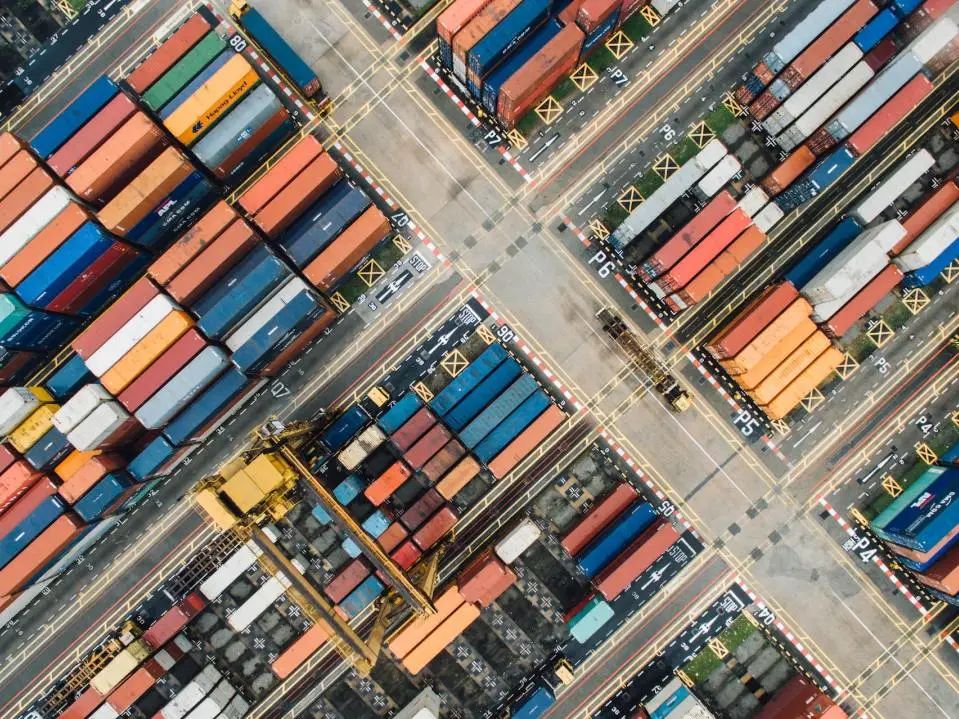
01. Congestion reasons: ship, equipment, and container area distribution
The scope of terminal yard congestion is different from that of port congestion. The former has a narrower scope and focuses more on operation, such as container yard location allocation; while the latter covers a wider scope and tends to control from a macro perspective, such as Chinese policies. Focusing on the congestion in the yard, there are three following main reasons:
Large-scale container ships
At present, the container vessel type has been developed into the sixth generation, with seven times carrying capacity that of the original type, and the ship with the maximum capacity in use can load 22,000 TEU. In accordance with the “Waterway Transport Market Development in 2021 and Market Outlook in 2022”, by the end of 2021,322 container ships with more than 700 TEU and 788,000 TEU were used for provincial transportation in China, with the number of containers decreased by 1.2% on a year-on-year basis, so that the development trend of large-scale ships is still obvious.
The large-scale ship brings many challenges to the terminal operation:
On the one hand, it puts pressure on the capacity of the yard. After the ship calls at a port, a large number of containers need to be transported from the front edge of the terminal to the yard through trucks, leading to a great pressure to the yard; on the other hand, it causes pressure to the horizontal transportation. Generally, container ships have fixed time to land and leave a port. In order to ensure the ship to leave on time, the number of quay cranes, trucks, and yard gantry bridges has to be increased to improve the loading and unloading transportation efficiency. At this time, the increase of large machinery narrows the road for trucks, which is easy to cause congestion.
The loading and unloading equipment in the yard is out of date
The loading and unloading capacity of the equipment in the process of unloading containers from the ship through the quay crane to trucks and then unloading from the trucks to the yard will directly affect the time for the trucks to and from the yard and the ship. Old loading and unloading equipment will result in slow unloading speed, increased waiting time of in terminal trucks, and multiple trucks parked near the yard, resulting in congestion in the yard.
Unreasonable allocation of container areas in terminal yard
The so-called container area allocation in the yard is that various containers, including import container, export container, and transfer container, are allocated to each sub-container area in terms of certain rules under the limit of yard container area capacity. For example, if a batch of hundreds of to tens of thousands of containers need to be exported, if all are concentrated near the same container area, the transport vehicles herein will be congested during the ship turnover, and the work load of the quay crane and the stacker in the area will be huge, so as to finally affect the actual loading efficiency.
02. Solution: Smart upgrading plays a key role
The measures to alleviate the congestion of the yard generally start from three directions: one is to expand the yard space; the second is to increase the loading and unloading speed; and the third is to improve operation management efficiency. Among them, intelligent upgrade optimization is crucial in the last two directions.
Enlarge the yard space and build outside depot
The construction of outside depot is one of the methods to deal with the congestion of yard, such as Shekou outside depot built in Ningbo Port and Daling Mountain outside depot built in Yantian Port. The area of the outside depot can be large or small in terms of the planning and design of the port's operation capacity, because on one hand, it can reduce the number of stacking layers of containers, the turning-box times of the terminal yard, and the waiting time of the in terminal trucks; on the other hand, it can transfer empty containers and delayed containers not taken to the outside depot to accelerate the handling speed of the containers in the yard.
Speed up the construction of automation terminals by increasing the speed of loading and unloading
In terms of the report of “Jiefang Daily” on November 24, China has made rapid progress on the construction of automated terminals in recent years, with 14 completed ones and 10 under construction. Compared with traditional terminals, a automated terminal composes of three parts: roadside operation system, seaside operation system, and closed yard operation system, so as to fundamentally avoid the circumstance of vehicle jam due to the simultaneous operation by inner trucks and outer trucks in a container area.
Promoting the construction of smart ports
The Smart Port refers to the deep calculation and wide interconnection of key information of each core of port supply chain with the help of new generation information technology such as Internet of Things, cloud computing, big data, and intelligent perception, so as to realize seamless connection, coordination and linkage between various resources and participants in the port supply chain. For the yard scenario, it can optimize the location and quantity distribution of the container area to a certain extent, so as to greatly avoid the congestion caused by human error in the horizontal transportation of trucks.
In order to further improve the transfer efficiency and safety of container, Westwell provides users with the global digital transformation solution WellOcean®. Aiming at the seaport scenario under the digital and intelligent ecological environment, it connects in series with various operation links of the terminal through unmanned horizontal transportation to enable the container large logistics system in an all-round way, aiming at the seaport scenario under the digital and intelligent ecological environment, based on the powerful algorithm, calculating, and other AI capabilities of Westwell, covering smart quay crane, smart yard gantry bridge, smart door machine, smart gate, intelligent transformation of port machine, smart safety supervision, and production operation system of the port area.
Westwell has achieved large-scale business landing and development of resilience in the world so far. As it develops showing resilience, its products and services have been established in 16 countries and regions around the world, serving more than 120 customers.
As the leader of new energy driverless commercial vehicles, we have become the enabler of intelligent upgrading of the traditional logistics industry with the vehicle as the carrier, the electricity as the core, the scenario as the support, and the transport capacity as the output. Specifically, by virtue of unique insight and global vision of container logistics, regarding unmanned driving products as the pivot and deep coupling scenarios, the container transportation capacity network is built to solve the problems of transportation, operation, and management in the whole operation process for terminal users from production nodes, trade process and other links, to promote the cost efficiency of container logistics scenarios such as seaport, railway port, land port, and factory, so as to boost the digital transformation and green energy upgrading of logistics scenarios with global thinking.
References
Ministry of Transport “Waterway Transport Market Development in 2021 and Market Outlook in 2022”
Wang Weibin. The Reasons and Responses on Container Terminal Yard Congestion [J]. China Water Transport (Second Half Month), 2019, 19(04): 43-44
Jiefang Daily “China has fully mastered the key technologies of the full chain of automatic container terminals with 14 fully automatic container terminals”.