


Products
Industries
LinkAige
About



Under the strategy of carbon peaking and carbon neutrality, the electrification of heavy trucks has become an important direction for carbon reduction in the automobile field. In accordance with the data of electric automobiles resources, the sales volume of China's new energy heavy trucks exceeded 10,000 in 2021, with a year-on-year growth of 299%. From January to May 2022, the year-on-year growth was 488%, with the sales of 7,703.
Behind the sharp increase in the sales of new energy heavy trucks, a new industrial ecology is taking shape. At the same time, in the context of energy crisis and high oil prices, how to return to its roots of electric vehicles quickly? How to address the high cost of initial purchase vehicles? They are also the focus of attention in the industry.
The EV battery swap industry policy in China has undergone multiple changes over a decade, with relevant exploration on both modes of charging and battery swap. In October 2021, the Ministry of Industry and Information Technology launched the driving application pilot of new energy vehicle battery swap mode, aiming at promoting over 100,000 battery swap vehicles and over 1,000 battery swap stations. So far, the full spread of the battery swap mode has blown the trumpet.
The battery swap mode, also generally called “vehicle-electricity separation” mode, refers to physical separation, i.e. the separation of battery from vehicle body structure for rapid replacement of power battery through battery swap device, and the separation of value, i. e. the separation of ownership and use right of a power battery.
Based on the basic characteristics of the battery swap mode, this paper will explain why it can become the way of the development of heavy truck electrification, and what exploration Westwell has made.
01. Battery Swap Mode Promotes the Development of Electric Heavy Truck Industry
Compared with traditional charging modes, the battery swap mode has four core advantages, forming the basis for accelerating the electrification of heavy trucks:
Firstly, improving the energy supplement efficiency. The energy supplement time is shortened from 2-3 hours in the past to several minutes, so the use efficiency of heavy trucks is improved;
Secondly, prolonging the service life of the battery. The battery needs to be detected and maintained after each battery swap operation, so that the damage to the power battery and the attenuation of the capacity are objectively reduced, and thus the service life of the battery is extended;
Thirdly, reducing the customer purchase cost of new energy heavy trucks. As the battery can be rented, the vehicle purchasing cost of customers in the early stage is reduced, in favor of promoting the large-scale application of the new energy heavy truck;
Fourthly, energy-saving. The customer selects the battery with the corresponding amount of electricity in terms of driving mileage, and the targeted matching enables the vehicle to be light enough to save energy.
Besides, the variety of power change modes helps the vehicle adapt to more scenarios. At present, there are many forms in the market, such as ceiling type battery swap, chassis type battery swap, side battery swap and so on. Among them, the ceiling type battery swap is the earliest commercial battery swap method with relatively simple technology; while the side battery swap is the most widely used battery swap method at present, which can be applied to various types of vehicles, but with higher requirements of intelligence and the needs to be equipped with laser radar and visual sensor.
From the point of view of the industrial chain, the battery swap mode has led to the birth of new business models, once triggered enterprises in various fields to stake out their turf and win by their own good. At present, the upstream of the battery swap core industry chain includes equipment suppliers (battery swap robot, station construction party, etc.); the middle is overall battery swap integrators, converting the upstream equipment into battery swap solutions; and the downstream is the operator of the battery swap station and the operator of the battery asset management company. It can be said that the battery swap mode can maximize the value of the battery life cycle, and redistribute the benefits in each link of the industrial chain, so as to help various parties to participate in and jointly realize ecological prosperity.
The market feedback also verified the development trend of the battery swap industry again. According to the data of tram resources, from the perspective of the proportion of battery swap sales in the sales volume of new energy heavy trucks, the proportion of such trucks has continuously increased since last year, rising from 18.1% in January 2021 to 50.8% in May 2022. In accordance with the calculation of GF Securities, it is expected that the scale of new heavy truck battery swap stations will reach over 4,500 in 2025.
02. Westwell Battery Swap Practice: PowerOnair-Efficient and Automated Battery Swap Plan
The market in the early stage of growth tends to leave sufficient imagination for companies to explore.
From the perspective of application scenarios, the battery swap heavy truck has high applicability in closed scenarios such as ports, land ports, factories, and mining areas. Because these scenarios are usually in a 24-hour continuous operation state with high frequency and heavy load, the heavy truck capable of battery swap within a few minutes can meet the demand of the scenarios for long battery life.
Furthermore, in short-term transportation scenarios such as shuttle transportation, a single battery of the battery swap heavy truck can support at least one round trip or one one-way; and the mode of quick battery swap can increase the number of transportation trips per unit time to improve the transportation efficiency.
Based on past technology accumulation and rich practical experience in the field of container logistics, Westwell launched a brand-new all-time automatic battery swap new energy heavy truck, Q-Truck, and a high-efficiency automatic battery swap solution supporting various vehicle types, PowerOnair, in 2022.
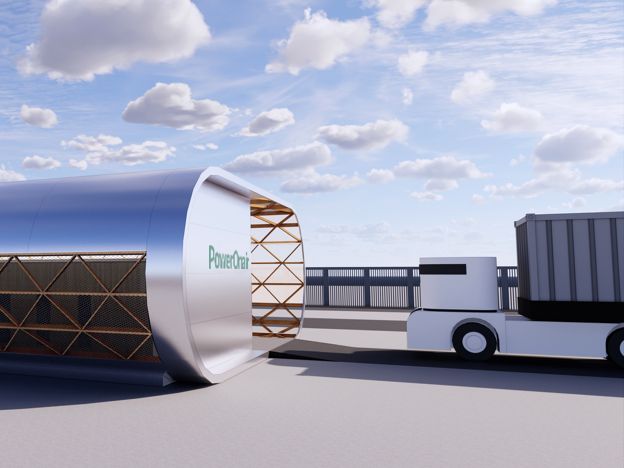
(Photo) <PowerOnair--Westwell Automatic Battery Swap Plan>
PowerOnair consists of a battery swap station and a cloud platform, with three following key features:
First, in the aspect of vehicle identification and positioning of the battery swap station, the self-developed perception laser positioning technology is adopted. When the battery swap vehicle drives into the station, the position data can be more accurately uploaded to the monitoring system, and the system can inform the precise position of the battery swap robot vehicle.
In particular, when the system detects that the vehicle is not parked in the specified area, it will interact with the vehicle in time to remind it to perform the second alignment through sound, display interface, signal transmission, etc. On the one hand, the battery can be accurately positioned and replaced; on the other hand, with the combination of Westwell own fleet management system (FMS), the business process of vehicle battery swap is smoother.
Secondly, Westwell exclusive design side battery swap robot. Compared with similar or other battery swap modes on the market, multi-directional safety guarantee technology is adopted. Through vision technology, infrared detection technology, mechanical structure design and the like, early warning and suspension in the process of battery swap can be realized, even if some emergencies are met, the battery swap process can be automatically stopped, and finally, the safety of battery swap under an automatic mode is ensured.
Thirdly, the cloud platform and data twin technology adopted by Westwell. Battery swap is only one of the steps in the battery swap process. Through the battery swap management cloud platform and the energy management center, data reports, big data analysis and other results will be provided for operation, so as to optimize the entire process and improve efficiency.
At present, there are common pain points in the industry, that is, inconsistent battery standards of various vehicle types, interfaces, and the battery swap modes, etc., affecting the versatility of the battery swap station and the large-scale replication capability.
In the design of PowerOnair products, Westwell Technology takes this into account early. Starting from hardware structure and communication interface, it provides standard module production to adapt to batteries of different sizes. In addition, the battery swap station can be split into multiple modules that are mutually related and independent, which is conducive to rapid repair and replacement to reduce the deployment time of the battery swap station. In the future, Westwell will continue to dig deep into “intelligence+greening” and work with industry partners to accelerate the construction of a new ecological environment of green development so as to promote sustainable social value innovation.
References:
Huatai Securities “Special Analysis on Battery Swap of New Energy Vehicles: Battery Swap Penetration Up, Entering Rapid Development Period”
GF Securities News “Special IX of New Energy Vehicles: Economy Promotes Industrialization, Battery Swap Heavy Trucks Start the First Year of Development”
AVIC Securities “Depth of Electric Vehicle Battery Swap Industry: Enhanced Certainty of Battery Swap Mode, Focus on Leading Enterprises”